
The Missouri countryside is teeming with wild animals. Deer are seen almost daily around here. Over the years you will see a wide range of animals. Unfortunately, mostly as road kill. Over the decades I have had some interesting encounters with wild animals.
Mammals
Coyote
Canis latrans

Ever since I was a child I recall hearing coyotes yelping in the night. Before we had air conditioning, I would sleep with my head close to the screened window and I would often hear owls and coyotes. There are a lot of farms in Boone County. In my experience, the primary complainers are owners of small livestock. Coyotes are a menace. Sheep farmers often have large dogs with white fur intermingle with their herds and this is usually effective.
As a country “gentlemen,” with no livestock, I find coyotes intriguing. My game camera has captured some beautiful shots of coyotes, but my most memorable encounter was while sitting in my back yard I saw a coyote nonchalantly wander across Prairie #2. About a third of the way across the yard he turned and noticed me. He did not panic, but looked me over for a bit, before proceeding toward the pond.
Eastern Cottontail
Sylvilagus floridanus

It is interesting how the presence of animals ebb and flow. As a young man, I counted as many as twenty one rabbits in one evening. I began to observe that they returned to the same location every day, making it easy to distinguish them. But the raptor population increased and when I moved into the old house in 2023, I did not see a single rabbit! There were also very few squirrels. But with two prairie projects ongoing, the rabbits have returned. They have most likely found refuge in the tall grasses. Now I regularly see anywhere from two to four rabbits at a time. Lovely little things as long as they stay out of the strawberry patch!
Eastern Deer Mouse

Peromyscus maniculatus
Aka — The field mouse by locals. It no longer suffices to call them “deer mice”, because there is a western deer mouse and an eastern deer mouse. My encounters with deer mice go all the back to my childhood. I would find them in brush piles, the wood pile and, of course, in the house. So many tales that it may warrant a special article on these little things.

Deer mice live virtually anywhere, and it is no surprise that I stumble across them while walking through either of the two prairie sites. I sometimes see them scurrying under brush piles.
My method for trapping them is to use a live animal trap. I do not use poisons because of the harm it does to domestic animals and people. Having 30 acres at my disposal, I find different places to release them.
Eastern Fox Squirrel

Sciurus niger
This was the squirrel that I grew up around. I did not recall seeing gray squirrels until I was in college. Fox squirrels are the biggest squirrel I have encountered. They have brown-orange bushy tails. They are aggressive raiders of the bird feeder and the subject of many YouTube videos.
As with the gray squirrels, the population of the fox squirrels has ebbed and flowed with the presence of raptors. But they are presently a few around.
Eastern Gray Squirrel

Sciurus carolinensis
When I was a kid about all I saw around the house were what we called “fox squirrels”, so labeled because of their long, bushy tails. But their true name is Eastern Fox Squirrel. There were a ton of them because they had few predators. Over time, the Eastern Gray Squirrel made its appearance and today are predominant. I rarely see a red squirrel. Their numbers have diminished considerably because of the abundance of raptors in the area.
Eastern Mole

Scalopus aquaticus
Alas, one of the pleasures of living the country life is that there is no pressing need pursuing moles. I think the pursuit of moleless yards is so suburban. The appearance of a mole above ground is rather rare, but I have seen them a few times in my life. This poor fella was apparently stunned by an animal, died of natural causes, or maybe succumbed to a sudden chill.
Muskrat
Ondatra zibethicus

The muskrat has been the one animal that rural Missourians love to hate. My father conducted warfare against the animals persistently over the decades. There was good reason for it. They loved to burrow into the banks of ponds, but it seemed like they preferred burrowing into the dam. Not cool. All it takes is for one to discover the opposite side of the dam and the next thing you have is a major leak. Good thing the neighbor was an enthusiastic trapper. Before long, there were no more muskrats. A few years later, they reappeared. The trapper, then a teenager, had now grown into a young man and was no longer in the area. So Dad carried out his stacked shotgun and dispatched them accordingly (and probably a dozen bass and frogs besides).

So I was not surprised to recently observe them swimming across the pond. The pond is no longer rimmed by barren banks. Much of the shoreline is lined with deeply rooted grasses, shrubs and trees, with an inner lining of cattails. The dam is also different, recently reinforced with an inner lining of large rocks and filled with an additional two feet of clay. Muskrats will find the large rocks a bit challenging to dig through (hopefully).

All this to say that I am not too concerned about the muskrats. This is now a wild pond, frequented by herons, ducks, and geese. And now a pair of muskrats.
Opossum
Didelphis marsupialis

Also known as the “possum”, these are the most peculiar creatures. My experience with opossums goes back to my childhood. Famous for their ability to feign death, they can fool you into thinking they are sluggish, dumb-witted animals. Far from the truth. I would find them in the trash barrel, a chore of which I totally despised. It was always cold. I would find them “frozen” at the bottom of the barrel. I would tip the 50 gallon barrel over (something a bit difficult for a twelve year old), take a long stick or pole, wait for them to clamp down on it, and drag them out. They would then pause for a moment to look me over, and scamper away before climbing a nearby tree.
As an adult, I have had them walk practically into me as I sat in a chair. Of course, I would not provide them the opportunity to come into contact, knowing the length of their teeth. They would see my movement, pause for a moment, turn around and walk away. I get the feeling their eyesight is awful. If you happen to be downwind from them and sitting still, they will come up very close.
Raccoons

Procyon lotor
My encounter with raccoons justifies a separate story, but a short description is due for this section. Raccoons are all over the place in our area. They are amazing animals to observe, but they can try your patience. Their ability to sabotage bird feeders, harangue chickens and upend garbage cans is highly recognized. In my experience I have had them raid the dog food, spin around on an old frying pan, inhabit my attic and put the fear of God in me as I maneuvered them in traps.
Yet for all the years I have dealt with raccoons, they have generally been well-behaved in my rural estate and I have not seen one as of late in Rachel’s Prairie. The game camera captured on during the night, but the picture is too fuzzy for this website. So I will make do, for now, with a web-linked photo to Wikipedia.
Red Fox

Vulpes fulva
I have had a long history with foxes. I have frequently seen them. There was a time I knew about every hole they crawled into. I would see them while camping or hiking. Around the house I have frequently seen them during the day (they are typically noctornal). They are intensely curious. I sometimes get this feeling I am being watched and I turn and, lo and behold, see a fox 20-30 yards away looking me over. For a few years there was one or two that stayed close to the pond.
Whitetail Deer
Odocoileus virginianus
Year-round.

Around here deer are seen almost daily. The herd has ranged from three to twelve. They are not domesticated, per se. They often walk into my back yard or the prairie while I sit quietly in a chair. The bucks are usually not pleased by my presence, snorting at me from behind cover. The deer get nervous if I am around, but don’t always take off and run. They have particularly been pleased with the development of the two prairies. The wild grasses and flowers are providing a more diverse, natural forage. There are also a wide range of mushrooms growing in the prairies and probably explains why on wet summer mornings they are seen grazing in broad daylight, sometimes sleeping in the grass (you know how mushrooms can be).

I have to watch my step in the spring. I nearly stepped on a fawn one time. I had a fawn approach me one time, only to discover it was covered with ticks, particularly around its eyes. Before I could get it to the vet, it wandered off. It was later discovered in our front flower bed, startling my wife as she was planting flowers. It ran away. I believe it survived the ordeal.
Insects
Bold Jumping Spider

Phidippus audax
The state spider of New Hampshire, the Bold Jumping Spider is probably the most frequently seen spider around our house. They are very shy and rather entertaining to watch.
Byssus Skipper

Problema byssus
Hmm. That’s an interesting name for a species. I wonder what the problema is? Sources do not state anything specifically pestilent about the species. It is classified as a butterfly.
What is probably most important about this butterfly is that it is a bellwether species. It is considered at-risk or endangered, depending on the location. Maintenance of tallgrass prairies is considered critical in perserving this population. It is encouraging to see that the tallgrass that is flourishing on Rachel’s Prairie may be one reason why this butterfly was observed. It is feasting on tall coreopsis.
Carolina Mantis
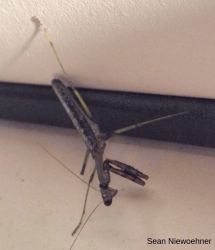
Stagmomantis carolina
Since delving into the world of insects, I have learned to be quite humble. When looking at the mantis, you immediately think of “praying mantis.” Maybe we have seen too many Mel Brook movies (Robin Hood, Men in Tights). But you will find the term strangely missing when identifying a mantis species.
This particular specimen found the side of our house attractive. It is one of the peculiar things of living alongside two prairie plots and acres of woods, that some of the most exotic insects find the side of your house the best place to go on display. It is probably the perfect combination of proximity, lights and bugs.
Common Buckeye

Junonia coenia
Common Crane Fly

Genus Tipula, Subgenus Platytipula
So it was in my youth someone accused this animal of being the male mosquito. So it was in mind for decades until I took the time to actually look it up. As I fly fisherman I encountered individuals who tied crane flies, being my first encounter with the actual name of this creature. While crane flies can be considered pests in some parts of the world, they are quite harmless around here.
Common Eastern Firefly

Photinus pyralis
The bug people love. Word has it that the firefly is endangered. Too much suburbia and bug spray. Fortunately, that is not the case here. Herbicide is not applied to the prairie projects nor the adjacent yard, and the results are an abundance of these fascinating creatures. It was one of my favorite events of summer to capture dozens of these bugs and contain them in a jar, watching their luminescence.
Today I often see them climbing amongst the tallgrass. As dusk approaches, they begin to drift from plant to plant in the prairie, sending out their soft green glows.
Delta Flower Scarab

Trigonopeltastes delta
This little critter was discovered inspecting the flower head of a Rattlesnake Master on Rachel’s Prairie, near the pond.
Eastern Amberwing

Perithemis tenera
Another “dragonfly.” Learning a lot in 2026. The dragonfly is now an Amberwing or a Skimmer. May need to confirm the exact species. Looks very similar to the Halloween Pennant.
Eastern Carpenter Bee

Xylocopa virginica
I still call them “bumble bees.” Bumble bees are one of those creatures that seemingly defy physics due to their ability to fly with wings that are disproportionately small for their bodies.
I go way back in my relationship to bumble bees. It would be the bumble bee that would get me over my fears of pollinators. One of my tasks as a young boy was to weed and trim the line of rose bushes along the road. This was no small task being that the fence row was about 100 feet in length. This was before the days of weed trimmers, so that meant getting on your hands and knees to clip out the tall grass and refresh the mulch around the bushes. One of my regular companions was the bumble bee. They would casually fly around the roses, buzzing around my head and hands as I worked. They never bothered me.
Later in life I would begin to appreciate why some folks refer to them as “carpenter” bees. I would practically walk into them while in the carport as they had this habit of simply hovering in place. Through observation I discovered them boring holes into the ceiling joists.
It is here that I must make a plug for the community at iNaturalist. It takes practice to identify many species and the “bumble bee” is one of them. With their help, I had to make a correction. I originally identified the bee as the Common Eastern Bumble Bee.
Today they are happily visiting the flowers on the prairies and in the garden. Fascinating to observe, there are about a half dozen species in Missouri, so many that MoDoC has devoted a page just for them.
Eastern Giant Swallowtail

Heraclides cresphontes
I encounter giant swallowtails frequently when I hike the woods. This one appeared at the edge of the wood, feasting on the nector of a Lateflowering Thoroughwort. Despite their considerable size, it has been very challenging to get a good picture of this butterfly. They are the stealth bomber of the species, with a near invisible profile as they drift through the forest and only a rare glimpse of their wings completely outstretched.
Eastern Pondhawk

Erythemis simplicicollis

Documenting what abides on our prairie sites has been a learning process. Early this spring, I knew these large flying insects as “dragonflies.” Now I have new names for them such as “Skimmer” and “Pondhawk.” The Eastern Pondhawk was originally spotted with color green. But later in the year, the same creature was discovered with the color blue. What the two have in common are experts identifying both of the samples as Eastern Pondhawks, and a distinct white tip on their tail. (Special thanks to the community on iNaturalist).
Eastern Tailed-Blue

Cupido comyntas
Eastern Tiger Swallowtail

Papilio glaucus
False Milkweed Bug

Lygaeus turcicus
No idea where it got its name from. It primarily feeds on False Sunflowers, and the leaves in the adjacent photo seem to match on several sunflower varieties found in or around Rachel’s Prairie. False Sunflowers have not been officially identified as of yet in the area.
Gall Wasp

Family Cynipidae
Appears in April and May.
Quite frankly — never seen one. I probably did, but I subliminally lumped them as just another one of a hundred bee and wasp species. But galls? Seen those since I was very young and always wondered what they were about.

So it was that I came across a bright green ball on the forest floor as I walked about the pond in 2026. Folks on iNaturalist helped identify the gall as that of the gall wasp. But identification of the species is down to the Family. So some additional information is required.
Is this an immature gall that fell on the ground? Almost all galls I have seen are on the tree. They are dry and rather fragile, yet firmly attached to the tree.
Giant Mayfly

Hexagenia limbata
Our bugs can get rather large, but the picture may fool you a bit. The body of the mayfly is approximately 1″. But it has a massive tail.
Great Spangled Fritillary

Argynnis cybele
You have heard people say so-so “strains at a gnat.” What do you call it when you can spend thirty minutes trying to determine if this orange butterfly is a Great Spangled Fritillary or a Meadow Fritillary. Before this year, I did not even know what a fritillary was, much less that there could be two species of these beautiful butterflies drifting about the prairies. I based my observation on the solid wave patterns at the forefront of the wings. Thanks to the experts on iNaturalist, I was able to confirm this butterfly as the Great Spangled Fritillary.
Horse Fly

Tribe Tabanini
Just when you thought it was safe to call this the “horsefly,” iNaturalist posts about a half dozen possible species in this area. So, for the time being, this photo will apply to the broader group, Tabanini. I must say I do not often encounter horse flies on the estate, and I cannot even recall seeing one on the prairie sights. They mostly will appear in my garage or around the house. I remember them by the dozens swarming around the barnlots and mud holes on the SE Missouri farm of my grandparents.
Japanese Beetle

Popillia japonica
Pardon the poor quality photo, but it was blown up to assist in identification. This is one bug that I am hoping I have misidentified. The Japanese beetle is highly invasive and destructive. At a glance, it has a native cousin, the June bug. But I see June bugs all the time and their color tone is browner.
Large Lace-border Moth

Scopula limboundata
A bit of a debate, due to the quality of this photo it is not certain whether this is a Large-Lace Moth or a Simple Wave Moth. Based on iNaturalist, there are not many observations of the Simple Wave in Missouri. Hopefully another opportunity will come along to obtain a better quality picture.
Leaf-footed Bug

Acanthocephala terminalis
Appears in late May
Sometimes called Coreids, Coreidea, or Stink Bugs. Will exude a pungent smell if cornered or smashed, but the “stink bug” is usually a related species, about half the size of the Leaf-footed Bug, and a frequent visitor to our gardens. This large bug is also a garden pest to some degree, but I see them less often and I typically encounter them in the wild. The adjacent photo shows one climbing on one of the domestic sunflowers.
Little Wood Satyr

Megisto cymela
Little Yellow

Eurema lisa
Amazing how well disguised an animal can be as this little creature almost comes off as a leaf changing color. But to find one of these sitting still is a challenge. They flourish in the prairie.
Luna Moth

Actias luna
Appears in May
Missouri is blessed with a range of beautiful moths and butterflies, but nothing beats the Luna Moth. Somewhere buried in my archive of photos is an actual picture of one in Rachel’s Prairie. But this moth perched on my kitchen screen will have to do for now. 🙂
Metric Paper Wasp

Polistes metricus
Appears in May
Can’t have an animal kingdom without a few bugs, right? I have never been a big fan of wasps. I learned not to fear dirt dobbers as a kid. But wasps? I started out on a bad note with those things. Was stung frequently up through my teenage years before I picked up the degree of caution necessary to avoid getting stung — like always knowing where you are placing your hands.

But wasps are pollinators. They have an important role in our world. I also noticed that wasps were about as likely to sting you as any other pollinator I would see in the garden or out in the prairie. Just let them be, and they will not bother you.
Northern Walkingstick

Diapheromera femorata
We certainly have remarkable insects in Missouri. I can recall as a boy watching my classmates boast of their discovery of a walkingstick as they opened a shoebox showing the creature perched on a branch. I have, on rare occasions, seen them in the wild. Unfortunately, a camera is not always handy. (They climb up and down trees and I am usually holding a chainsaw when I spot them.) Like most of us, I see them in Fall climbing up the side of the house.
Pearl Crescent

Phyciodes tharos
Observed several Pearl Crescents feasting on White Heath Aster in Kaitlin’s Prairie.
Periodical Cicada

Magicicada

The noise around the prairie can get surprisingly loud: redwing blackbirds, up to two dozen bird species, frogs, toads and crickets. But it can get rather intense when the cicadas emerge. Folks around Columbia are rather laid back by their presence. Depending on the species, they will appear every few years. They coat the trees, discarding their exoskeleton everywhere, and display some rather peculiar behavior. Topping my list was back in the 80’s when a hoard of cicadas blanketed the brick wall by the entrance of the supermarket.
The photos show the cicada in the wild and one that decided to check me out.
Pipeline Swallowtail

Battus philenor
This butterfly was not spotted on the prairie sites, but as a regular visitor to a freshly laid patch of gravel. What is it about the gravel that would attract this butterfly?
Red Admiral

Vanessa atalanta
So why is it called “admiral?” Well, this butterfly was photographed near the pond and Wikipedia notes that they prefer moist woodlands. Their preferred placement as larvae is stinging nettles, of which there are a few around the area, as well as a preponderance of horse nettle.
Saw-Wing Moth

Euchlaena serrata
Not everything I observe is on the prairie. Once in a while, the prairie comes indoors. This lovely thing appeared in our kitchen.
Slaty Skimmer

Libellula incesta
Another so-called “dragonfly.” These vibrant blue creatures make their appearance in July. Most are concentrated around the pond, but they scatter everywhere. I see them on the prairie, the garden and skimming over the white clover in the yard.
Small Milkweed Bug

Lygaeus kalmii
Evidently this milkweed bug likes feasting on mountain mint.
Spicebush Swallowtail

Papilio troilus
Appears in June. Getting these lovely things to hold still for a photograph is quite a challenge. I have been using a high-powered zoom lense, often standing a considerable distance from the butterfly, and then approaching a step at a time.
Butterflies love the prairie, but I often encounter swallowtails in the woods as well.
Spotted Orbweaver

Neoscona crucifera
I have frequently encountered orbweavers while hiking the trails in the nearby forest. This orbweaver was found along the side of my house.
Walnut Sphinx

Amorpha juglandis
Pictures don’t always provide perspective. This moth is fairly large, fitting comfortably in the palm of your hand. Did not find this beautiful moth in the prairie, but in the old garage. The old garage and carport were being upgraded to finished rooms. This poor thing had found its way into the old garage and camped out on the window screen. I gently guided the moth into a cup and carried it outside.
Western Honey Bee

Apis mellifera
Yes — this is the ordinary “honey bee.” But domesticated? Not so sure. Honey bees can travel 1-2 miles to gather pollen. There are not that many folks who live in that radius and as far as I can gather no one is a beekeeper. Beehives have frequently been encountered by folks who live around here, often while cutting down a tree in Fall and Winter. Trust me, if you are cutting down a tree in our forest in Summer, you better check out the tree thoroughly.

As pictured, honey bees love white clover and the yard adjacent to the two prairie sites is full of it. But I have seen honey bees on numerous occasions feasting on the flowers in the prairies. As a young man, I watched my father gather honey from his beehives and we both learned how prairie flowers affect the quality of the honey. White clover honey is almost clear and sweet. The prairies will generate a lot of golden rod in late Summer and Fall, producing honey that is sulfuric in smell and taste — basically food for winter for the hive.
These honey bees were introduced by settlers from Europe, but they are not considered invasive. They are semi-domesticated. While used extensively in agriculture, many bee colonies have wandered off to find new homes in the hollow of trees and, unfortunately, in the cavities of a house or barn. Seeing a honey bee in your yard is a good sign.
Widow Skimmer


Libellula luctuosa
This is my first attempt to identify what I had always called “the dragonfly.” The first thing I learn, using iNaturalist, is that it is a “skimmer.” I have always had close interaction with dragonflies, a frequent companion whenever I am around the pond. On occasion they may land on you, but they generally just fly wherever they please.
Yellow-based Tussock Moth

Dasychira basiflava
This little fella camped itself over the lens of the game camera. Stayed there for some time, accounting for hundreds of blurry images.
Reptiles and Amphibians
I am setting up a separate category for “Turtles.” While researching turtles I quickly discovered that this a learning process. There are a lot of species out there, many of which look similar. Just when you think a turtle is a turtle, you discover there are “sliders” and “cooters.”
American Toad

Anaxyrus americanus
Found frequently in the area is the American Toad. Like most kids, I grew up messing with frogs and toads, and unquestioningly believing that the urine of a toad causes warts. That is not true, of course. But it is peculiar how they tend to let loose whenever you are handling them. I also grew up generally associating toads with the land, and frogs with the pond. That is true to some degree, but there are numerous exceptions. American toads breed and then lay their eggs in water. Their hatchlings will crowd the shorelines of the pond as tadpoles. Eventually they transform into toads and make their way to the feeding grounds on dry lands. They prefer areas with thick grass and shrubs. Rachel’s Prairie and the nearby pond are a perfect match.

Our front porch has evolved to be a popular gathering place for toads and tree frogs, probably due to the combination of light and bugs. They seem to be well fed. We have to take care whenever we step out at night to avoid stepping on the poor things.
Common Five-Lined Skink

Plestiodon fasciatus
And here it is I have been calling it a lizard all these years! While the photo was taken on the front porch, I frequently encounter these skinks while walking out in the prairie and around the pond. Unfortunately, their shyness, speed and the proximity of brush to hide within conspire against me whenever I attempt to photograph them in the wild. But these animals can be somewhat domesticated where they get comfortable being around you. It is no surprise that our almost daily encounters on the front porch allowed for this particular fella to hold still long enough for a photo. My experience is the same with prairie lizards. The ones in the garden and along the garage no longer scurry off when I come by, but simply look me over and casually walk away.
Licorice Twizzler

Glycyrrhiza Torta
Found this near the road adjacent to Rachel’s Prairie. With all the snakes we have around here, you can’t be too careful.
Pond Turtle
Appears in March — as soon as there is some warm sunshine.

I am sure that over time I will nail down the exact species of this turtle, but for now it is “pond turtle.” Actually saw one of these things burrowing into the flower bed uphill from the pond where I am cultivating bulb flowers. Almost appeared like “she” was laying some eggs. Will see.

The pond has dozens of these type of turtles. They are not “box turtles.” I typically will catch them sunning themselves along the pond bank.
Prairie Lizard

Sceloporus consobrinus
Appears in May.
These little creatures keep appearing in wood piles, gardens, my front porch and along the brick retaining wall. The ones in the wild are a bit skittish, never holding still long enough for a photo. But the garden variety seem to know me, don’t run and pose for a picture. 🙂
Red-bellied Snake

Storeria occipitomaculata
Sounds like an insult from a Western movie. This little guy is about the length of your forearm.
Three-Toed Box Turtle

Terrapene triunguis
Begin to move around a lot in May.
You know, after 65 years of observing turtles, I never bothered to count their toes. Turtle identification is a learning process. We all become familiar with identifying a turtle by looking at the top of their shells. But did we ever stop to count their toes? The conventional “box turtle” is actually the Three-Toed Box Turtle.
Western Rat Snake
Pantherophis obsoletus

Maybe it’s a technicality, but this is the black rat snake, not the black snake. We had another label for the rat snake. We called it the “bull snake,” but the more you probe into the world of snakes the more you discover that local descriptions of these creatures can be considerably in error. I still have a friend who swears that he killed a “cottonmouth,” but I am not positive they are present in this part of Missouri.
The peculiar feature of the black rat snake is its potential size. It can get to be as long as 6 feet. Black snakes, on the other hand, are no longer than three feet. The same applies to the infamous cottonmouth. Of these three snakes, the cottonmouth is venomous.
The snake pictured was a frequent visitor to my garden, which is not far from Rachel’s Prairie. I noticed it slithering its way into the tall prairie grass.
Resources
- Peterson Field Guides: Mammals, William H. Burt, ed. and Richard P. Grossenheider, Illus., Houghton Mifflin Company, Boston, 1980
- iNaturalist — HIGHLY RECOMMENDED. I appreciate so much the input of volunteer specialists and scientists who contribute.
- Facebook: Missouri Snake Identification and Education Group
- Missouri Department of Conservation Field Guide
Please note that, unless clearly designated in the photo, photos are from the Creative Commons, usually Wikipedia.
© Copyright 2026 to Eric Niewoehner
Last updated